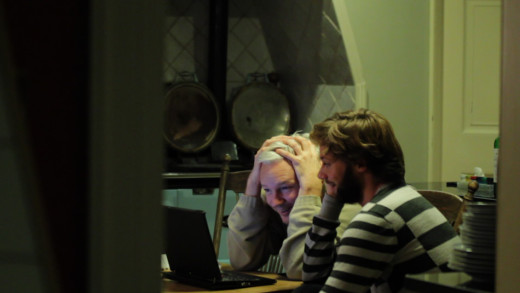
 1:34:02
In Mediastan, an undercover team of journalists drive across central Asia interviewing editors of local media outlets to publish secret US diplomatic cables that were provided to WikiLeaks in 2010. Success is varied. And so, after regrouping with Julian Assange in England, questioning the editor of the Guardian, and obtaining candid footage of the New York Times editor and its publisher Arthur Sulzberger, Mediastan closes by leaving the viewer with an informative first-hand overview of the machinations of mainstream media. By venturing into the minds—and actions—of the people and institutions who shape the news, Mediastan shows the system for what it's worth, and reveals its true motivations...
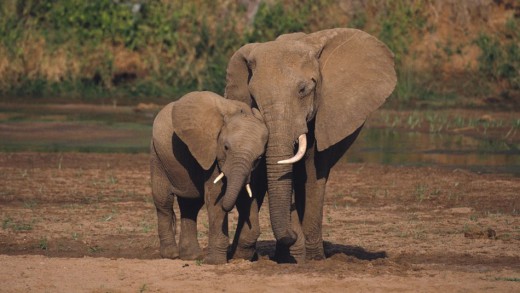 39:38
39:38By taking the example of documenting the conditions in zoos and circus shows, An Apology to Elephants is a film about the institutional cruelty to animals and their environments. In the circus, elephants are whipped, beaten and struck with hooks—a pain-compliance technique called bull-hooking—to perform tricks and behave according to the requirements of captivity. The film also looks at the prevalence of the ivory trade, stating that the current elephant killing rate would lead to extinction of the species in ten years. The film is a call to more than an apology, it's a call to stop these sadistic institutions and repair the damage done to animals and the environment by this culture.
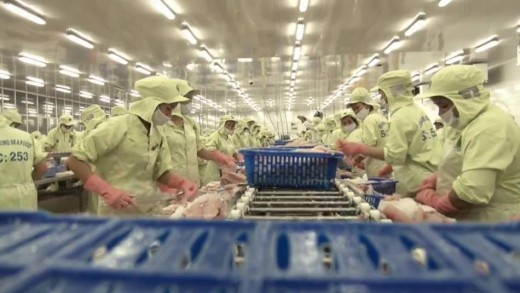 54:27
54:27In the past 40 years, global consumption of fish has doubled. Having decimated natural fish populations globally, the industrial food system has turned to mass-scale farming practices in order to sustain the unsustainable, supplying huge supermarket chains and commercial food outlets with cheap processed fish products. What do we know about this and these processes? And what of the lives of the fish? What about their health and the health of the waters in which they're taken? Fillet-Oh!-Fish is the result of yet another indictment of the industrial food system, agriculture and factory farming—all of which have egregious implications to the health and well-being of species, and the planet as a whole. We see myriad mixes of pesticides and other chemicals, leading to toxic rivers and streams, the pervasiveness of the industrial food system, with glimpses into working conditions and processing methods, as well as the perniciousness of globalisation, with the world-wide reach of this crazy system that has hijacked a fundamental life-giver: food.
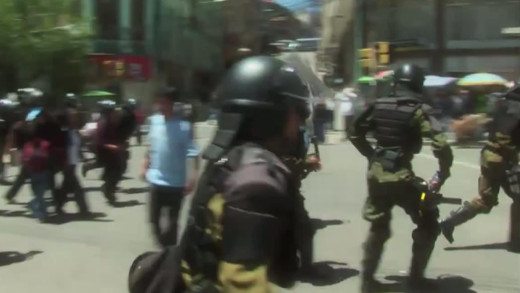 25:04
25:04How To Stop A Multinational follows three women in Argentina as they put themselves in harms way to stop a gold mining company from entering their town. With the activists having defeated a Canadian mining company, the campaign is now against a Chinese one that wishes to extend the operation, making use of large quantities of fresh water--up to 45,000,000 litres per day--a plan that seriously threatens the future viability of the town and the environment. This short film documents the campaign which is still in its early days, where activists carry out a series of direct-actions to stop the mining company from physically entering the town; training villagers, informing others and filming the outcomes along the way...
 1:44:28
The Square
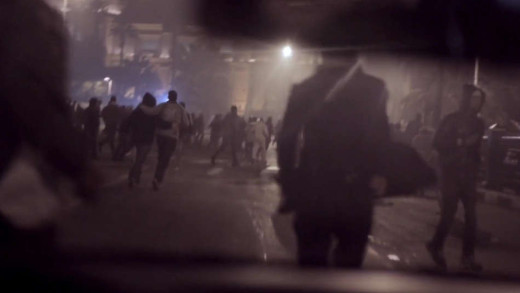
The Square follows the anti-government protest movement in Egypt through the eyes of six very different activists, starting in Tahrir Square in 2011, up until the 2013 coup d'état. The film follows the activists on a life-changing journey through the euphoria of victory into the uncertainties and dangers of the current military rule, where everything they fought for is now under threat or teetering in the balance. The Square becomes an immersive experience, transporting the viewer into the intense emotional drama and personal stories behind the revolts. It is an inspirational account of people asserting their rights, struggling against multiple forces--from a brutal army dictatorship willing to crush protesters with military tanks, to a corrupt Muslim Brotherhood using mosques to manipulate voters; a struggle unfinished, unfolding.
 1:03:04
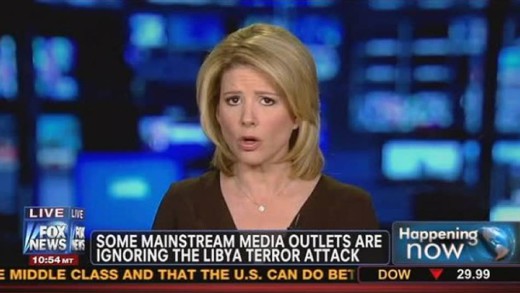
Project Censored explores the inner workings of mainstream media in the United States—a media which is often claimed as a free press in a democratic society. But is this really true? Instead what is revealed is a widespread and systemically entrenched culture of censorship and omission throughout the corporate media, as well as a gripping control over media content by centralised corporate control. Project Censored brings to light stories that have been deliberately suppressed, or at the very least obscured and 'hollowed-out' by entertainment values over real news content or discourse. Citing a range of examples and modern mainstream media techniques, Project Censored takes a critical view of this information arrangement that has huge implications for real democracy...
 1:25:09
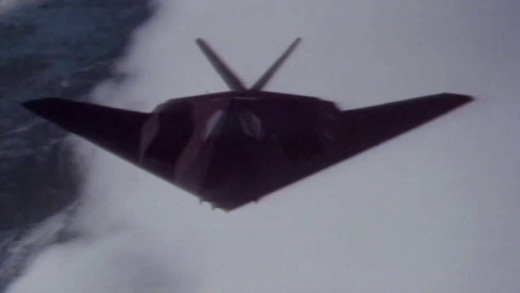
Mirage Men examines evidence of a conspiracy by the United States military to fabricate UFO folklore over decades in order to deflect attention away from classified military projects. The film profiles a retired Special Agent, Richard Doty, who worked for the United States Department of the Air Force Office of Special Investigations, and the United States Air Force Office of Special Investigation, and speaks about his role in special operations that targeted both individual people, and the public at large for many years. The film also weaves in the viewpoints of others, either in the sphere of the myths, or working to uncover their origins.
 47:17
47:17Peter Francis, a former undercover police spy turned conscientious whistleblower, breaks ranks by speaking to the media after becoming troubled by the unaccountable culture of secret police operations throughout the United Kingdom targeting peace activists for decades. Tactics included undercover police officers having sexual relationships with activists, even going as far as commonly having children with the women they were spying on. Undercover agents also often assumed the identities of dead children in order to have "solid cover stories." We also see how undercover police were asked to look for intelligence that could be used to discredit the family of murdered teenager Stephen Lawrence and their campaign. The Lawrence family both speak of their shock at hearing about that the police did this to them. This short investigation opens a flood of questions about the secret history of covert police operations, and indeed the future of them in the context of the sprawling surveillance state of today.
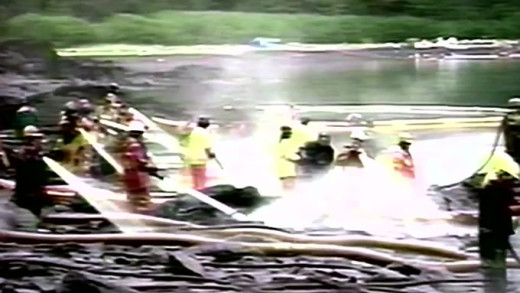
Stop the Flows is a media project in progress to document resistance movements around the world that are working towards stopping the flows of oil and gas, minerals and other natural 'resource' extraction from within their communities, territories and landbases; as well as stopping the flow of the tremendous amounts of wealth generated from these destructive activities. This series aims to support and capture the many forms of organising, direct-action, protest and resistance movements throughout the world working to end mining, the oil economy, nuclear power and more...
 34:27
34:27Damocracy
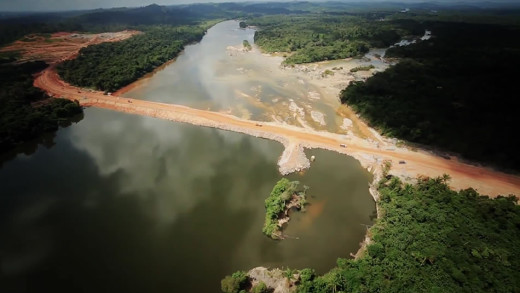
Damocracy travels from the deepest corners of the vast Amazon rainforest in Brazil to the mountains and plains of fertile upper Mesopotamia in south east Turkey, to expose the myth that large-scale dams, as clean energy, are a solution to climate change. The film records the priceless cultural and natural heritage the world will lose in the Amazon and Mesopotamia if two planned large-scale dams are built--the Belo Monte dam in Brazil, and the Ilisu dam in Turkey. Damocracy documents the story of resistance by the thousands of people who will be displaced if the two projects go ahead, and issues a call to the world to support this fight to save the last rivers from industrial civilisation...
 2:05:02
Gasland Part II
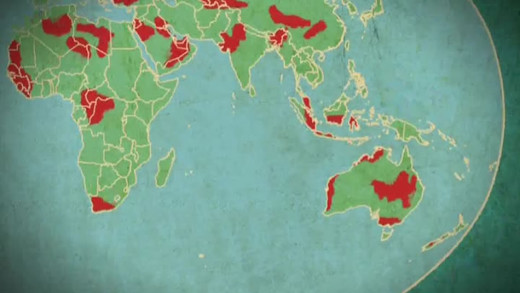
Gasland Part II follows on three years later, to continue documenting how the stakes have been raised on all sides in one of the most devastating environmental issues rapidly spreading the globe. This sequel further enriches the argument that the gas industry's portrayal of natural gas as a clean and safe alternative to oil is a lie, where in fact fracked wells inevitably leak over time, and vent exuberantly more potent greenhouse gasses such as methane in cumulative effect, not to mention the continued string of cases of severe water contamination across the United States and even cases as far away as Australia. Gasland Part II follows deeper into these happenings, revealing yet more of an entrenched corporate collusion in the pursuit of exploiting dwindling 'natural resources'...
 50:29
50:29The Wall Street Code explores the once-secret lucrative world of prolific algorithmic trading by profiling an inside programmer who, in 2012, dared to stand up against Wall Street and its extreme culture of secrecy, to blow the whistle on insights into the way the modern global money market works. His name is Haim Bodek—aka 'The Algo Arms Dealer'—and having worked for Goldman Sachs, his revelations speak to the new kind of wealth made only possible by vast mathematical formulas, computer technologies and clever circumventions of laws and loophole exploits. Vast server farms and algorithms working beyond the timescale of human comprehension, have largely taken over human trading on the global financial markets for decades. What are the implications of that? The algorithms seem to have a life of their own. Snippets of code secretly lie waiting for the moment that your pension fund gets on the market; trades done in nanoseconds on tiny fluctuations in stock prices. And the only ones who understand this system are its architects—the algorithm developers. The Wall Street Code provides just a small insight into this new world of high-frequency trading, amongst other things...
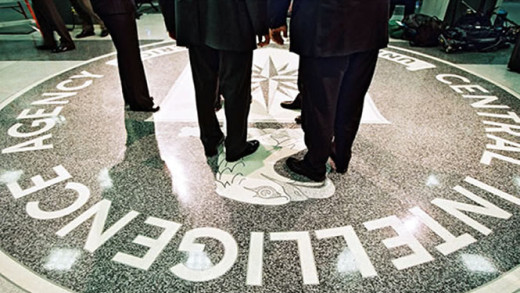
Counter-Intelligence is a 5 part series that explores in-depth, the vast, sprawling and secret National Security State that operates throughout the United States--and indeed the world. The series examines the foundations of the Military-Industrial-Intelligence Complex, charting through to the myriad consequences in today's world where secret intelligence organisations continue to hijack governments, manipulate elections and commit heinous crimes against humanity--all under the cloak of "National Security". In the wake of the continued revelations of the NSA PRISM program, this series is now more important than ever to provide a solid historical context to the workings of the rapacious and ever-expanding National Security State...
 52:14
52:14Your retirement plan, if you're even lucky enough to have one, is a gamble. Fees, self-dealing, kickbacks, deregulation and/or no regulation at all brings great profits to the financial system, while imperiling the future of individuals who provide 100% of the funds, take 100% of the risks, but only get 30% of the returns. Even the privileged Baby Boomer generation now faces uncertainties, to say nothing of those who come after and face an even more staggering wealth inequality. The paternalistic "American dream" of the 1950s has long been over. Now, thanks to decades of neoliberalism, with a financial system geared towards short term profits and externalising risks and costs, the retirement fund industry is a ten trillion dollar industry, protected by obfuscation and complexity. The Retirement Gamble offers a window into this racket, raising just some of the troubling questions about how this supposed system claims to "work for everyone" when it does nothing of the sort, by design.
 25:27
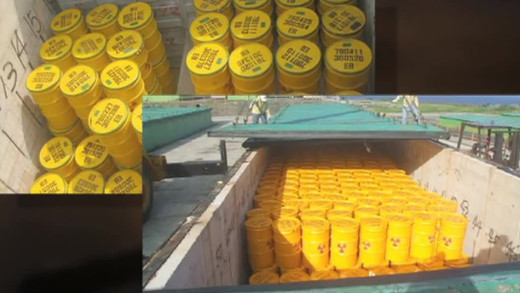
25:27Just along the fault lines of the Pacific Rim of Fire from Japan, lies Taiwan--another heavily industrialised, modern economy highly reliant on nuclear power. Ninety percent of the world's earthquakes occur along the Rim of Fire, so no wonder there are worries about a fourth nuclear plant being built there. The government of Taiwan is promising to hold a referendum on its future, but if the reactor doesn't go ahead the country's nuclear strategy is in question, along with the $9 billion already spent on the plant. And the state-owned power company, Taipower, would face bankruptcy, leaving no one to manage Taiwan's nuclear waste. The waste currently sits across the water on the tiny Orchid Island, quickly corroding and risking potential disaster for the native Tao inhabitants. As fears grow, can we learn from Fukushima before it's too late?
 33:39
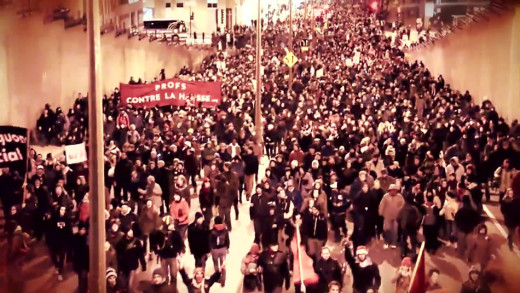
33:39In the spring of 2012, a massive student strike in opposition to a tuition hike, rocked the streets of the Montréal for over six months. Protests and mass direct-action on the street became part of daily and nightly reality. Several times during the tumultuous spring, the numbers in the streets would reach over one hundred thousand. Police routinely clubbed students and their allies, and arrested them by the hundreds. Some were even banned from entering the city. But every time the cops struck, the student movement got bigger and angrier. This is a story about how the arrogance of a government underestimated a dedicated group of students, who through long-term organising, laid the foundation for some of the largest mass demonstrations in Canada's history.
 1:09:10
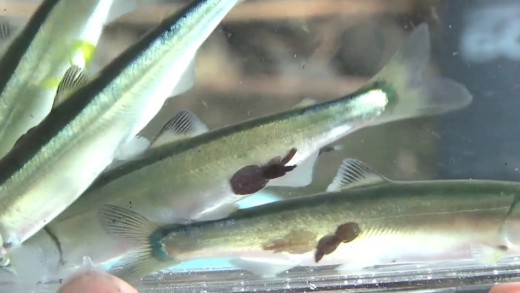
Salmon Confidential follows renowned biologist Alexandra Morton as she finds that wild salmon are testing positive for dangerous European salmon viruses associated with industrial salmon farming worldwide, and then, how a chain of events is set off by the Canadian government to suppress the findings. Scientists are gagged, research suppressed, evidence not allowed. With the industrial fish farms having moved into Morton's neighbourhood in the late 1980s, since then, there has been a serious decline in wild salmon in the region. So, tracking her findings, the film follows Morton and her team as they move from courtrooms, to Canada's most remote rivers, Vancouver grocery stores and sushi restaurants, providing insights into the workings of government agencies tasked with managing the 'safety of fish and food supply,' that always seem to put industry and the needs of corporations over the natural world, time and time again. Salmon Confidential becomes a call to action to help save the wild salmon from these atrocities, before they're completely wiped out forever.
 1:36:21
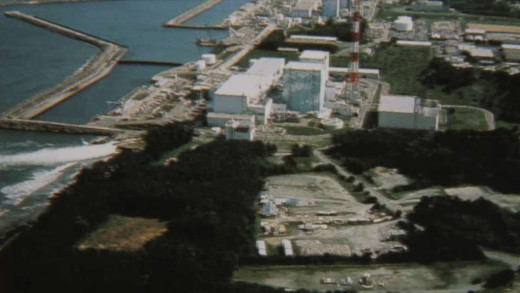
On 11th March 2011, a huge tsunami, triggered by an 8.9 magnitude earthquake, hits Japan. It cripples the Fukushima Daiichi nuclear power plant, releasing radiation, and turning the residents of Futaba into nuclear refugees. The devastation experienced by the town--dead livestock, crops abandoned, homes destroyed--was infinitely worse than anything reported by the newspapers. A year later, many refugees are still unable to return to homes that will be contaminated for many hundreds of years. The irony of this disaster occurring in a nation that experienced two nuclear bombs is not lost on the victims who poignantly question their responsibility for striking a Faustian bargain with nuclear power. Nuclear Nation examines the tragedy of Fukushima, and also whether it could one day be replicated on a grand scale.
 1:08:12
White Like Me
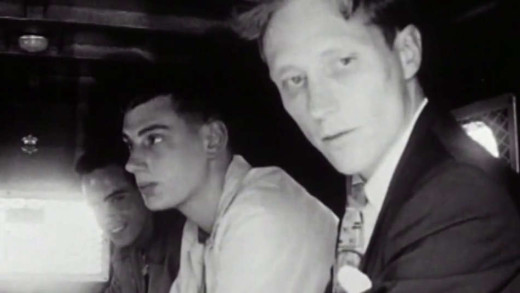
White Like Me, based on the work of acclaimed anti-racist educator and author Tim Wise, explores race and racism in the United States through the lens of whiteness and white privilege. In a stunning reassessment of the American ideal of meritocracy and claims that we've entered a post-racial society, Wise offers a fascinating look back at the race-based white entitlement programs that built the American middle class, and argues that our failure as a society to come to terms with this legacy of white privilege continues to perpetuate racial inequality and race-driven political resentments today.
 1:35:04
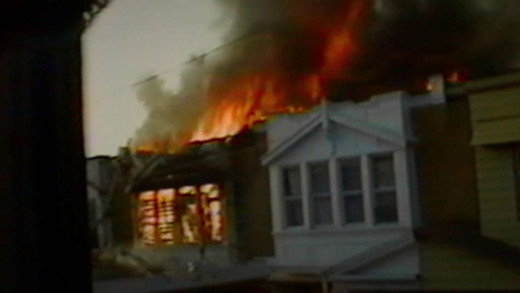
Let the Fire Burn documents the conflict of the City of Philadelphia and the Black Liberation organisation MOVE, that led to a disastrously violent confrontation in 1985. MOVE was originally established as a "back to nature" movement that practised green methods, and in May 1985, the Philadelphia Police Department decided to take action to evict the group from their row house at 6221 Osage Avenue. When gunfire broke out and tear gas was not enough to pull the MOVE members out of the house, the police decided to drop explosives on the house. A fire soon began to blaze, endangering the several children now trapped inside the house. In a controversial decision, the police opted to let the fire burn, resulting in the destruction of over 60 homes and the death of five children and six adults. Eleven people died in the resulting fire, and more than 250 people in the neighbourhood were left homeless. Ramona Africa, one of the two survivors, said that police fired at those trying to escape. The investigation commission that followed found that city leaders and law enforcement had acted negligently, but no criminal charges were filed.
 1:29:20
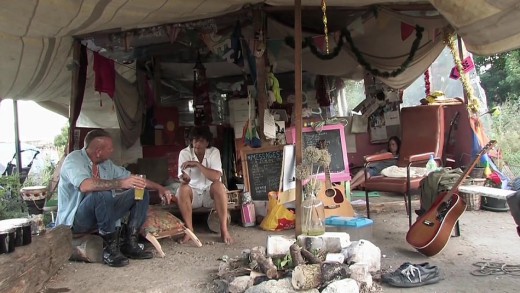
Two years before the Occupy movement sprang forth in New York, a small group of land-rights activists occupied a piece of disused land in west London to create an "alternative model of moneyless, sustainable living" which they labelled, the Eco-Village. Echoing the dynamics of hippy communes in the United States decades earlier, Grasp the Nettle follows the often bewildering and even amusing actions of this group through many moments of idyllic beauty, as they use local trees and recycled rubbish to build small homes, go dumpster diving, build a manually operated shower and compost toilet, create a local seed bank, and help distribute dumpstered sandwiches to the city's homeless. But the Eco-Village quickly becomes something other than just an idealistic experiment in political protest. It begins to attract vulnerable people who already live on the margins of society and need help: the homeless, the unemployed, alcoholics, the mentally ill. Some of them are invited to stay, but others cause a ruckus and harm the group. Tensions spark as the community grapples to deal with the increasing chaos while trying to stave off the fast-approaching prospect of eviction, through the ideologies of withdrawal, dropping out, freemanism and spirtuality. Grasp the Nettle is hence a valuable reflection of the efficacy of this type of Wandervogel-style activism, where lack of goals and support infrastructure, a diverse array of internal conflicts and horizontal hostility can be the ultimate undoing of idealistic and much-needed political resistance movements.
 1:18:29
The Kill Team
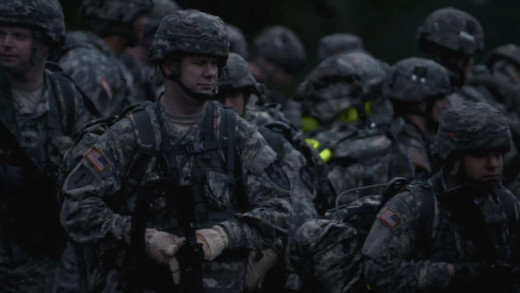
The Kill Team profiles four young American men, who referred to themselves as the "Kill Team," that carried out a string of war crimes in 2010, during the United States' invasion of Afghanistan, systematically murdering Afghan citizens. The film focuses on Private Adam Winfield who attempted, with the help of his father, to alert the military to the murders his platoon was committing. His pleas went unheeded. Faced with threats to his life from superior officers and other members of the military, Winfield makes a split-second decision that changes his life forever. The Kill Team follows Winfield and his family through the wartime events and legal proceedings that follow, interspersed with interviews of the other soldiers involved, and video footage from Afghanistan, revealing first-hand revelations of a war culture rooted in hatred, social pressure, and sociopathy.
 1:30:00
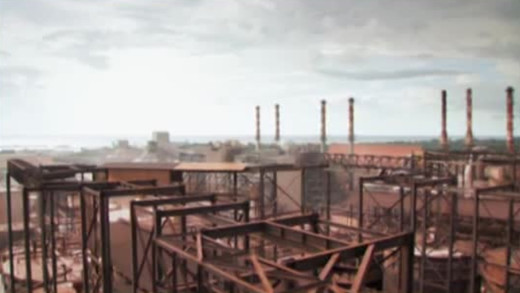
Aluminium is everywhere—beer cans, tinned food, cooking pans, computers, pens, cosmetics; and many medications, including most vaccinations. Though what do we know about this material? The Age of Aluminium profiles people whose health has been seriously impacted by unwitting exposure to aluminium; along with research exploring how aluminium as a known neurotoxin relates to the growing epidemic of chronic illnesses and disabilities such as breast cancer, Alzheimer’s disease, allergies, and autism. Aluminium mining and manufacturing have also created cataclysmic environmental problems in several parts of the world, as we see the devastating effects of aluminium mining in South America, and environmental disasters in Hungary and the UK. What are we doing with this material? And what can we do now to avoid the continued impacts on our lives and the natural world?
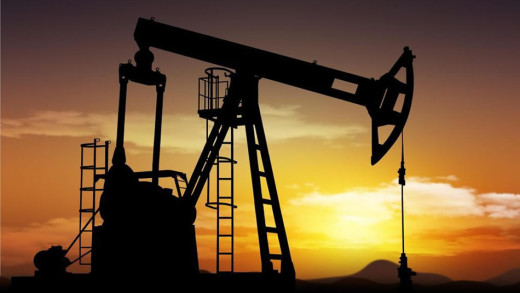
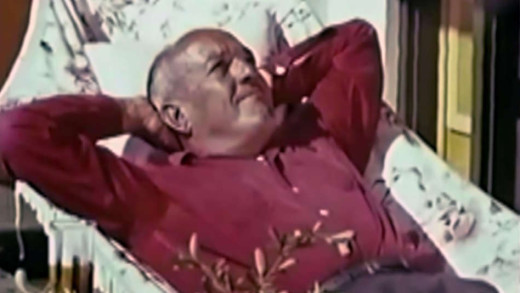
The Secret of the Seven Sisters is a four-part series examining the rise of a powerful cartel of seven companies that control the world's oil supply. The 'seven sisters' comprises Anglo-Persian Oil Company (now BP); Gulf Oil, Standard Oil of California (SoCal) and Texaco (now Chevron); Royal Dutch Shell; Standard Oil of New Jersey (Esso) and Standard Oil Company of New York (Socony), (now ExxonMobil). Prior to the oil crisis of 1973, the Seven Sisters controlled around 85% of the world's petroleum reserves, but in recent decades the dominance of the companies and their successors has declined. This series is about the power of oil, the conspiracy of business, and the control that oil provides the few...
 25:30
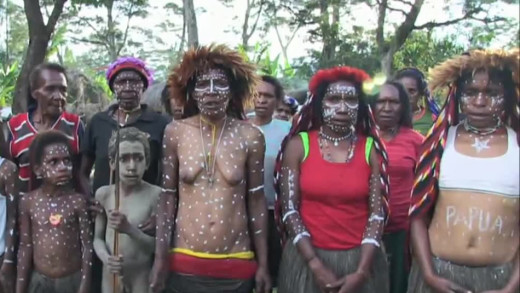
25:30Goodbye Indonesia investigates one of the world's most forgotten conflicts--the West Papuan struggle for independence. When the Dutch decolonised their empire after the Second World War, they handed it all to the emergent country of Indonesia--all except the territory of West Papua, which forms one half of New Guinea, the second largest island on Earth. This remarkable landmass split neatly by colonial powers into West Papua and Papua New Guinea, is like few other places in the world...
 53:17
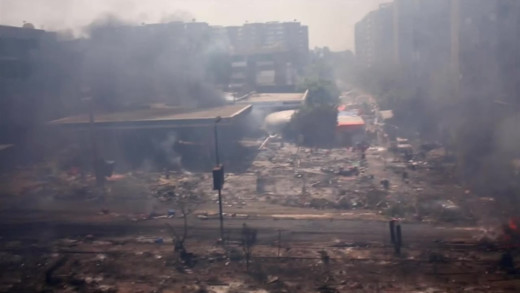
53:17Less than three years after a popular uprising that led to President Hosni Mubarak's ousting, and just one year after Egypt's first elections, the elected government has been overthrown and the Egyptian military is running the state. And the Muslim Brotherhood—the secretive, long-outlawed Islamist group that came out of the shadows to win the presidency in June 2012—is once again being 'driven underground.' Were the Brothers ever really in charge? Or was the Egyptian deep state—the embedded remnants of Mubarak's police force, Supreme Court and, most of all, military—in control all along? In Egypt in Crisis, we go inside the Egyptian revolution, tracing how what began as a youth movement to topple a dictator evolved into an opportunity for the Muslim Brotherhood to seemingly find the political foothold it had sought for decades—and then why it all fell apart. With Egypt's hopes for democracy in tatters, and the military-led government violently cracking down, what will happen next?
 42:25
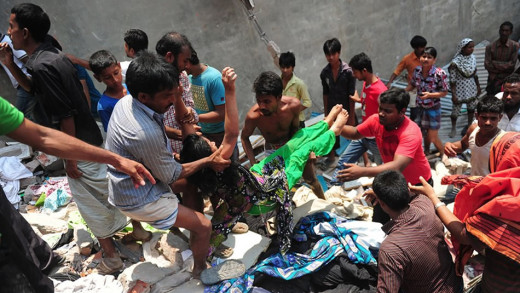
42:25Fashion Victims looks at the real cost of cheap clothes from the conditions of sweat shops in Bangladesh. On 24th April, 2013 more than a thousand people were killed when an eight storey building collapsed in the heart of Bangladesh's capital, Dhaka. The collapse of Rana Plaza turned the world's attention to the shocking conditions workers in the country's clothing industry are forced to endure. In recent years, Australian companies have flooded into Bangladesh to take advantage of lax labour laws and the lowest wages in the world, paid to the predominantly young, female workers in the factories.
 16:41
16:41Using undercover filming, Sex and Survival in Madagascar exposes the booming child sex trade of the 21st Century. In the hub of Madagascar, one of the world's poorest countries, prostitution is rampant and seen as an unavoidable means of survival. The film shows the complicity and complacency of authorities that do not act to stop this terror, and so the acts of resistance against sex slavery are carried out by the children themselves.